Important Notice The content on this website is for craft and hobby purposes only. Results may vary based on individual skill, materials, and conditions. We do not guarantee specific outcomes from following our guides.
Background
Start weaving now

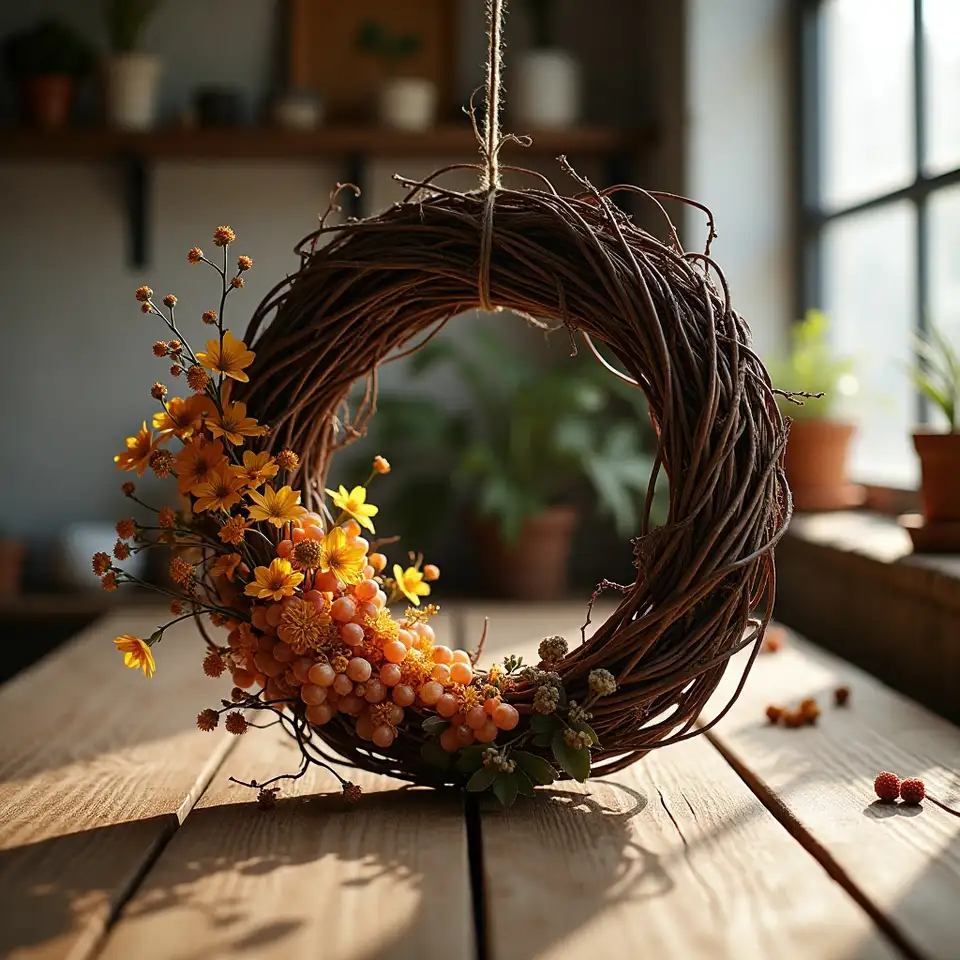
Shape Wild Grapevines Into Beautiful Wreath Bases

From tangled fence-line clippings to sturdy seasonal foundations

Most beginners grab a vine and pull. It cracks. They try again. It splits. The frustration builds until the craft gets abandoned in a corner. We teach a different approach. Soak first. Bend slowly. Let the vine guide your hands. The result is a sturdy, organic base ready for any season.

Essential Tools and Workspace Setup

Grapevine wreath forming requires minimal investment. The vine does the hard work. Your job is to prepare the space, gather a few reliable tools, and create conditions where the material can perform.

Your First Grapevine Wreath Base

A complete walkthrough from raw vine to finished form

    01

    Harvest with intention

    Cut dormant vines during winter months when sap is low. Select lengths between one and two meters with consistent thickness. Remove leaves, tendrils, and damaged sections before storage.
    02

    Soak until yielding

    Submerge cut vines in clean water for twenty-four to forty-eight hours. Test flexibility by bending a single strand. If it snaps, soak longer. The vine must fold without cracking before weaving begins.

    03

    Form the anchor loop

    Create a tight central circle by wrapping the thickest end around itself. Tuck the working end through the loop to lock the starting point. This anchor determines the final wreath diameter.
    04

    Spiral with tension

    Wrap the working vine around the anchor loop, feeding the end through previous coils to create interlocking tension. Do not pull hard. Let the vine's natural spring lock each layer into place.

    05

    Tuck and finish

    When the desired thickness is reached, tuck the final end securely into the coil structure. Trim any protruding pieces. The base should hold its shape without wire, glue, or binding.

    06

    Dry slowly and evenly

    Place the finished base on a ventilated surface away from direct heat or sunlight. Slow drying preserves the tension you built. Rush this step and the wreath warps or weakens.

Advanced Shaping Techniques

Move beyond basic rounds into complex forms and professional finishes

Skill

Reading vine personality

Each vine has a grain direction and natural curve. Work with these tendencies rather than against them. The best makers adjust their approach to suit the material in their hands.

Reading vine personality

Each vine has a grain direction and natural curve. Work with these tendencies rather than against them. The best makers adjust their approach to suit the material in their hands.

Skill
Build

Multi-vine layering

Combine thin and thick vines in alternating layers to create visual depth and structural strength. Start with the thickest for the core, then wrap finer material for surface texture.

Multi-vine layering

Combine thin and thick vines in alternating layers to create visual depth and structural strength. Start with the thickest for the core, then wrap finer material for surface texture.

Build
Fix

Troubleshooting cracks

Cracks usually mean insufficient soaking, working against the grain, or pulling too hard. Re-soak the damaged section, reverse your twist direction, and reduce grip pressure.

Troubleshooting cracks

Cracks usually mean insufficient soaking, working against the grain, or pulling too hard. Re-soak the damaged section, reverse your twist direction, and reduce grip pressure.

Fix
Design

Asymmetrical shaping

Not every wreath must be a perfect circle. Extend one side, flatten another, or create organic free-form shapes by varying coil density around the perimeter.

Asymmetrical shaping

Not every wreath must be a perfect circle. Extend one side, flatten another, or create organic free-form shapes by varying coil density around the perimeter.

Design
Timing

Seasonal adaptation

Spring vines are sappier and harder to dry. Autumn vines are brittle and need longer soaking. Adjust your timeline and technique to match the season you are working in.

Seasonal adaptation

Spring vines are sappier and harder to dry. Autumn vines are brittle and need longer soaking. Adjust your timeline and technique to match the season you are working in.

Timing
Finish

Professional finishing

For sale or gift pieces, trim all ends flush, check for protruding bark, and test structural integrity by gentle squeezing. A quality base feels solid and looks intentional.

Professional finishing

For sale or gift pieces, trim all ends flush, check for protruding bark, and test structural integrity by gentle squeezing. A quality base feels solid and looks intentional.

Finish

Common Questions